


Bladder & Ureter Endometriosis Surgery
When endometriosis grows into the bladder wall or wraps around a ureter, surgery removes it from the outside, where it starts, and frees the ureters to protect your kidneys.
- How
- Robotic excision from outside the bladder
- Protects
- Kidney and bladder function
- Catheter
- Often for several days after a bladder repair
Medically reviewed by Dr. Steven Vasilev, MD
Board-Certified Gynecologic Oncologist & Integrative Medicine Diplomate, Advanced Robotic Endometriosis Excision Surgeon, Director of Lotus Endometriosis Institute · Updated Nov 2026
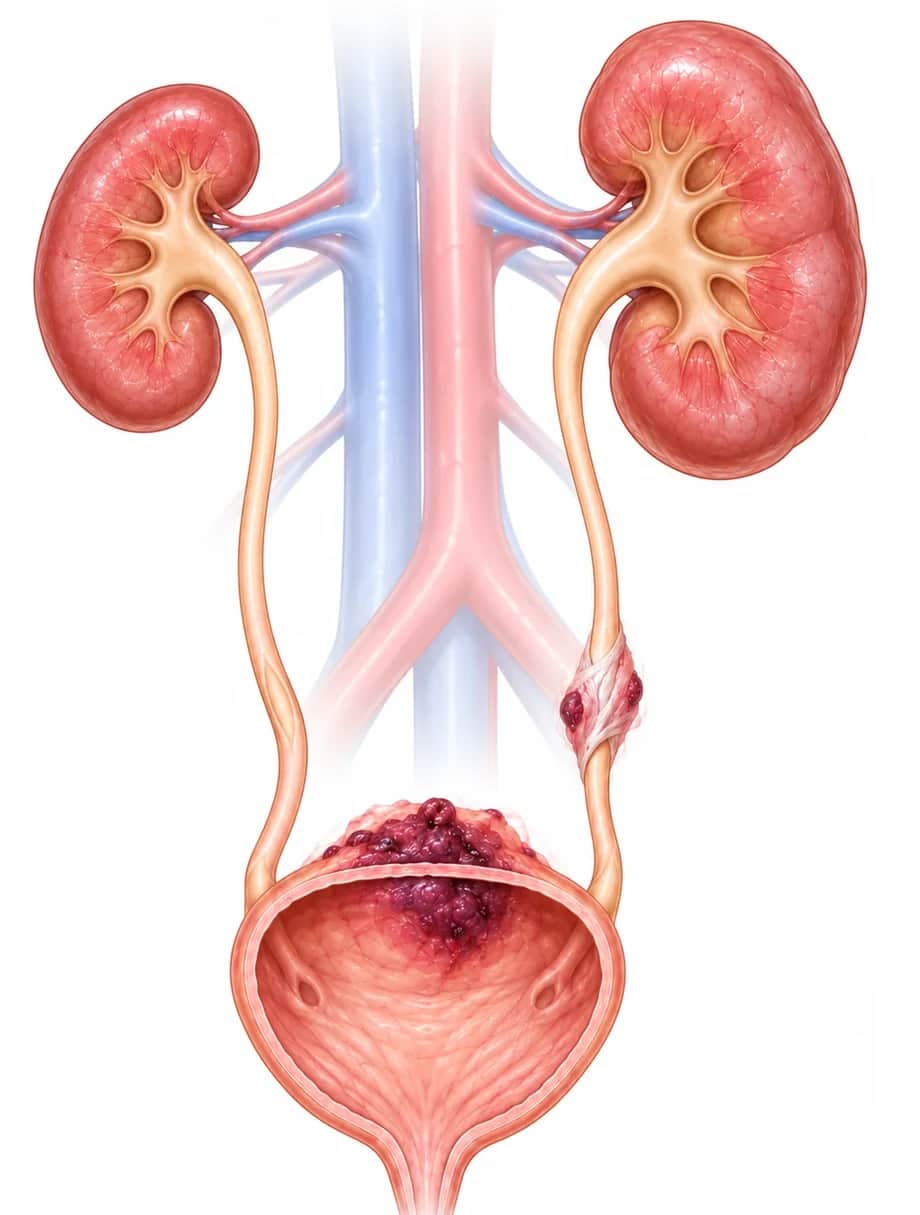
- The bladder wallA nodule growing in from the outside, removed and the wall repaired.
- A narrowed ureterScar tissue and endometriosis squeezing it, freed in the same operation.
- The kidney above itDrains through that ureter. A blockage can make it swell, often without pain.
Endometriosis
Why a ureter can be blocked without pain
Scar tissue can narrow a ureter slowly, with little or no pain, while urine backs up into the kidney. That's why the ureters and kidneys are checked before surgery, even when you have no urinary symptoms.
Who it’s for
Is it right for me?
When urinary symptoms flare with your period but tests show no infection, imaging shows a bladder nodule, or a ureter is narrowed.
The pattern to look for is burning, pressure, urgency or frequency that flares around your period. You may have been treated again and again for "UTIs" the cultures never show. Blood in the urine with your period is uncommon, but a strong sign when it happens.
A bladder nodule can show on an ultrasound done with a partly full bladder, or on MRI. A narrowed ureter or a swollen kidney is often found on imaging before it causes any pain. Hormones can ease the symptoms, but they don't remove a nodule in the bladder wall.
Most urinary symptoms in endometriosis don't mean the bladder needs surgery. But a ureter can narrow silently, so it's always checked.
Often improves
- Pain with urination, pressure and urgency caused by endometriosis
- A narrowed ureter, freed to protect the kidney
- Blood in the urine with your period
- Deep pelvic pain, when the rest of the disease is removed in the same operation
Won’t fix on its own
- Bladder pain syndrome (interstitial cystitis) or a sensitized bladder
- A lifetime cure: endometriosis is a chronic disease
Bladder symptoms can have more than one cause, so care continues after surgery with pelvic floor therapy and pain management when they're needed.
Your options
How does it compare?
Removing it from outside the bladder reaches the whole nodule and the ureters. Treatment from inside the bladder, or medication alone, usually doesn't.
Endometriosis grows into the bladder from the outside in. Robotic excision from outside the bladder removes the whole nodule, by shaving it off or by removing a small piece of bladder wall and repairing it. The ureters are checked and freed in the same operation.
A scope through the urethra (TUR) trims only what shows inside the bladder, so the rest usually stays, and it can't reach the ureters. Hormone medication removes nothing: symptoms often return when it stops, and it doesn't protect a ureter that is narrowing.
| Compared | Excision from outside the bladder | Removal from inside the bladder | Hormone medication |
|---|---|---|---|
| What it is | Robotic surgery: the nodule is shaved off, or a small piece of bladder wall is removed and repaired | A scope through the urethra trims what shows inside the bladder (TUR) | Pills, an IUD or injections that quiet the disease |
| What it removes | The whole nodule, which grows from the outside in | Only the inner part; the rest usually stays | Nothing; symptoms often return when it stops |
| The ureters | Checked and freed in the same operation | Not reached | Not protected if one is narrowing |
| Recovery | Often a catheter for several days after a repair, then a gradual return | Usually short | No surgery; side effects vary |
Excision from outside the bladder
- What it is
- Robotic surgery: the nodule is shaved off, or a small piece of bladder wall is removed and repaired
- What it removes
- The whole nodule, which grows from the outside in
- The ureters
- Checked and freed in the same operation
- Recovery
- Often a catheter for several days after a repair, then a gradual return
Removal from inside the bladder
- What it is
- A scope through the urethra trims what shows inside the bladder (TUR)
- What it removes
- Only the inner part; the rest usually stays
- The ureters
- Not reached
- Recovery
- Usually short
Hormone medication
- What it is
- Pills, an IUD or injections that quiet the disease
- What it removes
- Nothing; symptoms often return when it stops
- The ureters
- Not protected if one is narrowing
- Recovery
- No surgery; side effects vary
From first visit to recovery
What happens, step by step?
A video consultation, imaging of the bladder, ureters and kidneys, a plan agreed in advance, then one operation.
It starts with a video consultation about your symptoms, urine test results, imaging and any earlier operations. An ultrasound with a partly full bladder, or MRI, shows how deep a nodule goes, and the kidneys are checked for swelling. Whether the bladder needs shaving or a repair, and whether a urologist joins, is agreed in advance. Insurance and a fixed price are settled before anything is booked.
On the day, the ureters are found and protected first, then the nodule is removed. If the bladder was repaired, a catheter keeps it empty while it heals, often for several days. Urgency or mild burning settle as it heals. Three months on, a video check-in goes over your pathology results.
Before surgery
Planning consultation
By video, with your symptoms, urine test results, imaging and any earlier operative reports.
Imaging the urinary tract
An ultrasound with a partly full bladder, or MRI, shows how deep a bladder nodule goes. The kidneys are checked for swelling, a sign that a ureter is narrowed.
Cystoscopy, a look inside the bladder, helps in some cases, for example when there's blood in the urine. Because the disease grows from the outside in, a normal cystoscopy doesn't rule it out.
Your plan
Whether the bladder needs shaving or a small repair, whether a ureter needs freeing, and whether a urologist joins the operation, all agreed in advance. Insurance and a fixed price are settled before anything is booked.
Surgery day
The operation
Robotic, through small incisions. The ureters are found and protected first; then the bladder nodule is removed, and the bladder repaired if needed, along with the rest of the pelvic disease.
Rarely, a narrowed piece of ureter has to be removed and the ureter reconnected to the bladder. That's planned with a urologist or gynecologic oncologist, not decided on the day.
Often in the same operation: endometriosis excision · bowel surgery
In the hospital
Most often it is still a same-day outpatient procedure. When it isn't, how long you stay depends on everything that was treated. If the bladder was repaired, a catheter keeps it empty while it heals, often for several days; sometimes it comes out before you go home.
Recovery
Early recovery
Weeks 1–2
Urgency, frequency or mild burning are common at first, and settle as the bladder heals.
A gradual return
The weeks after
Back to work and exercise in stages, with clear guidance from your team on lifting and activity.
Follow-up
Follow-up
3 months
Your pathology results and a video check-in. If a ureter was freed or repaired, a scan checks that the kidney drains well.
Your surgeon
Who should do it?
A surgeon who can remove disease from the bladder and free the ureters in the same operation, with a urologist when needed.
The bladder and ureters sit in the middle of deep pelvic disease, and scar tissue pulls them out of place. Many surgeons stop there, or treat only what shows inside the bladder. Dr. Vasilev trained as a gynecologic oncologist for exactly this space: removing disease from around the bladder and ureters while keeping them working.
“A ureter can be blocked without a single symptom. Checking for it is part of every plan in cases where advanced disease is suspected.”
Patients often ask
What does bladder endometriosis surgery involve and how is recovery?
Bladder endometriosis surgery may involve shaving a lesion off the bladder surface or removing a small segment of bladder wall and repairing it. Recovery typically includes a temporary urinary catheter for several days, and early urinary symptoms usually improve as healing progresses.
Will I need a catheter after bladder endometriosis surgery?
Often, yes, at least briefly, but it depends on what is needed to fully remove the bladder lesion. If surgery involves a full-thickness excision and bladder repair, a catheter is more commonly used to keep the bladder empty and protect healing.
Can endometriosis block a ureter without pain?
Yes, endometriosis can compress or narrow a ureter with little to no pelvic pain, especially when scarring gradually narrows it over time. This can silently back urine up toward the kidney, causing swelling and risking loss of kidney function.
Can medication cure bladder endometriosis lesions, or is surgery needed?
Medication can often ease bladder endometriosis symptoms, but generally does not remove deep bladder wall lesions. Surgery becomes more important if symptoms persist despite medication, imaging suggests deeper muscle invasion, or there is bleeding or urinary blockage.
You’re on step 1 of 3
Next: Who should operate?What to look for in any surgeon, and Dr. Vasilev’s results.