
Endometriosis
Endometriosis isn’t one disease — it’s many.
Diversity in immune responses, hormone receptor expression, and transcriptomic profiles all suggest that endometriosis manifests uniquely in each individual, requiring personalized diagnostic and therapeutic approaches.
One Size Does Not Fit All
Understanding Endometriosis
The Lotus Endometriosis Institute takes a unique stance on endometriosis that you are unlikely to find elsewhere. Recent molecular and genomic research strongly supports the notion that endometriosis is not a single disease entity, but a heterogeneous condition composed of distinct subtypes. Each of these subtypes have potentially different origins, clinical behavior, and treatment responses. Some of it is genetic, some of it you can influence, and some you cannot.
What is it?
Endometriosis is a condition where cells similar to the uterine lining (endometrium) grow outside the uterus, potentially into the pelvis or abdomen. The condition has varying severities and symptoms.
When can it happen?
Endometriosis can occur at any age. It can be found in your teens, early childhood, or even earlier in-utero as a fetus. The condition primarily affects middle aged women, but can also be post-menopausal.
Why does it occur?
The exact causes are not currently known, and they likely differ from person to person. Contributors possibly include embryologic müllerianosis, genetics & epigenetics, molecular translational changes, pelvic tissue transformation called metaplasia and more. It is most definitely "multi-factorial" and "polygenic".
Where can it spread?
Endometriosis can affect not only your pelvic organs and delicate structures, which include your bladder, ureters and rectum, but also outside your pelvis higher up in the abdomen. There it can involve your intestines. Endometriosis can spread literally anywhere in your body, including the lungs (metastatic) and beyond.
Common Issues
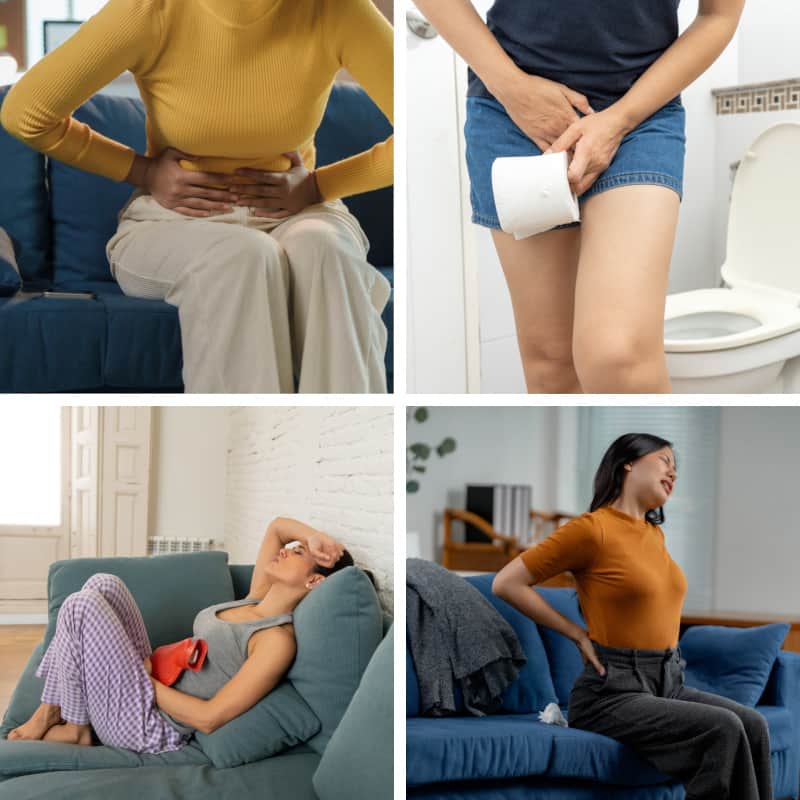
Symptoms
Endometriosis often presents with symptoms that can vary greatly in severity and impact, making it challenging to recognize early. While some people experience debilitating pain, others may have subtle signs that are easily overlooked or mistaken for common menstrual issues. Understanding the range of potential symptoms is the first step toward earlier diagnosis and effective treatment.
Pelvic / Abdominal Pain
Persistent or cyclical pain in the pelvis and lower abdomen is one of the most common symptoms, often worsening around menstruation but not limited to it.
Bloating
Abdominal bloating, sometimes called “endo belly,” can appear suddenly, feel severe, and fluctuate day to day.
Painful Sex
Discomfort or sharp pain during or after intercourse is common, often tied to inflammation, scarring, or adhesions.
Infertility
Endometriosis can interfere with fertility by affecting the ovaries, fallopian tubes, or pelvic environment, though many with the condition do conceive with treatment.
Urinary Frequency
Some experience urgency or frequent urination, particularly if lesions involve the bladder.
Painful Bowel Movements
Bowel movements may trigger cramping or sharp pain, especially during menstrual cycles.
Back and Leg Pain
Pain can radiate into the lower back, hips, or legs, reflecting how endometriosis affects surrounding nerves and tissues.
And Far More
Symptoms extend well beyond this list, with wide-ranging effects on the body and quality of life—making awareness and individualized evaluation essential.
Because Your Experience Matters
Every symptom tells a story—we are here to listen to yours.
We understand how overwhelming and isolating these symptoms can feel, and you don’t have to face them alone. At Lotus Endometriosis Institute, we combine world-class surgical expertise with integrative, whole-person care to uncover the true root of your pain. This unique approach gives you the best chance at lasting relief, restored health, and a better quality of life. Take the first step toward healing—reach out today and let us help guide you forward.
Different for Everyone
Subtypes & Stages
The ASRM (American Society for Reproductive Medicine), defines four stages of endometriosis. The stages are not necessarily proportional to pain or symptoms. Some patients exhibit less pain than others, even if they have a higher stage diagnosis. Additionally, the condition can be described by different "subtypes" including: superficial endometriosis (on peritoneal surface), deep infiltrating endometriosis (invading tissues), ovarian endometriomas ("chocolate cysts"), metastatic endometriosis (spread to distant areas), and malignant degeneration (rare but life-threatening).
Stage 1 - Minimal
There are small patches or implants either on or around the organs in the pelvis.
Stage 2 - Mild
Increasing number of implants but damage to the pelvic organs is still minimal with not much scarring or adhesions. Altogether, the implants are not more than ~5cm.
Stage 3 - Moderate
Implants are more widespread and are beginning to infiltrate the organs in the pelvic region, including pelvic side walls, ureters, and peritoneum. There is more scarring and adhesions and endometriomas (“chocolate cyts”) on the ovary.
Stage 4 - Severe
The disease is infiltrating and affecting several organs (e.g. bladder, rectum) in the pelvic region, as well as the ovaries. Anatomy is severely distorted with scars and adhesions, with fibrosis (like concrete) between organs. Larger and more endometriomas can be seen.
Insights for Your Health
Prevention and Detection
While the near future may bring molecular genetic insights into targeted prevention, today there is no reliable way to prevent endometriosis. In fact, there is a genetic predisposition which is not well understood. If you have a relative with endometriosis, you have a 5-7x risk of being affected. What those genetic switches are will be uncovered soon and prevention and treatment will be enhanced. Meanwhile, you can do a lot towards reducing the chances it will affect you and maybe decrease endometriosis progression. We provide integrative insights into endometriosis-reducing lifestyle-modifications, and they are as natural a strategy for endometriosis treatment as it gets.
Excision Surgery Leads the Way
Surgical Treatment
Surgery plays a central role in endometriosis care, serving as both a diagnostic tool and today’s gold-standard for initial treatment of pain relief, infertility, and suspicious masses. Because endometriosis can vary depending on where it is located—inside or outside the pelvis—and what stage it has reached, treatment must be carefully tailored to each individual. Minimally invasive excision surgery offers accurate diagnosis while providing effective symptom relief, but it should be strategically timed, as repeated procedures can increase scar tissue and risk. For the best outcomes, the benefits must always outweigh the risks, making timing and the expertise of the surgeon essential to every decision.
Common Questions
How is multi-organ endometriosis treated without organ removal?
In many multi-organ cases, the goal is conservative surgery: removing endometriosis while preserving the organs themselves. That typically means meticulous excision of disease from surfaces and deeper planes around the bowel, bladder, ureters, ovaries, and pelvic sidewalls—freeing organs from scar tissue and restoring normal anatomy without taking the organ out. Because endometriosis can hide in distorted or “frozen” anatomy, the safest way to preserve organs is often a highly precise approach that can dissect around vital structures.
In our practice, we use robotic excision to improve visualization and fine-control dissection, which is especially helpful when disease involves multiple compartments or has been operated on before. When endometriosis is close to structures like the ureters, bowel, diaphragm, or certain nerves, treatment planning may include coordinated work with other surgical specialists so the disease can be fully addressed in one operation while still prioritizing organ-sparing techniques.
Organ removal is usually considered only when an organ is severely damaged, there are multiple large endometriomas that can’t be safely managed with tissue-sparing techniques, fertility-safety concerns arise (like a badly damaged tube), or there’s concern for tumor or malignant change. If you’re trying to avoid organ removal, we can help map likely disease sites, clarify your priorities (pain relief, function, fertility), and outline what organ-preserving excision could realistically look like in your specific case—then build a surgical plan around that.
Why do I have painful urination and pelvic cramping between periods?
Painful urination with pelvic cramping between periods can happen when the bladder, ureters, uterus, pelvic floor, or nerves are being irritated—sometimes in a way that still follows a subtle cycle pattern even if you’re not actively bleeding. Endometriosis can contribute by affecting the bladder wall or tissues around the bladder and ureters, and symptoms don’t have to include visible blood in the urine. Importantly, urinary tract endometriosis isn’t always “obviously urinary,” and ureter involvement can be quiet while still significant, which is why we take these symptoms seriously.
These symptoms can also come from conditions that overlap with (or mimic) endometriosis, such as bladder pain syndrome/interstitial cystitis, pelvic floor overactivity, adenomyosis-related uterine cramping, or other pelvic pain drivers. In our evaluation process, we focus on your full flare pattern—what triggers it, how it relates to your cycle, and whether urine tests have been repeatedly negative—then use targeted exam and the right imaging (often expertly interpreted ultrasound and/or MRI) to map what’s actually going on.
If you’re noticing recurring burning with urination, pressure, cramping, or symptoms that predictably flare mid-cycle or before your period, that pattern is useful diagnostic information—not something to dismiss. You can explore our urinary symptom and diagnostic evaluation resources to see how we approach “UTI-like” symptoms with negative cultures, and you’re welcome to reach out to schedule a consultation so our team can help you sort out whether this is bladder/ureter endometriosis, a look-alike condition, or a combination.
Why do I look pregnant from bloating with constant pelvic pressure?
Feeling so bloated you “look pregnant” along with constant pelvic pressure usually points to more than simple gas—often it’s a pelvic condition creating inflammation, swelling, or a sense of bulk. Endometriosis can irritate the bowel and pelvic lining, trigger scarring that tethers organs, and create the classic “endo belly” sensation that comes and goes (sometimes not perfectly cyclical). Pelvic pressure can also happen when endometriosis involves deeper tissues or nearby organs like the bladder, ureters, or rectum.
Just as important: these symptoms can be driven by endometriosis neighbors or coexisting conditions, especially adenomyosis and fibroids, which can make the uterus feel heavy, full, or “bulky” and add pressure on the bladder and bowel. Ovarian cysts and other benign pelvic findings can contribute, and IBS-like bowel sensitivity can overlap so closely that symptoms alone don’t reliably sort out what’s causing what. Our team focuses on mapping the full picture—uterus, ovaries, bowel, bladder, and pelvic support structures—so treatment targets the true driver(s), not just the most obvious diagnosis.
If this pressure/bloating is persistent, worsening, or changing your ability to eat, move your bowels, or urinate comfortably, it’s a strong reason to pursue a deeper evaluation rather than being told it’s “normal.” You can explore our educational content on bowel symptoms, bladder symptoms, and overlapping conditions, and reach out to schedule a consultation so we can review your history, imaging, and symptom pattern and outline a plan aimed at lasting relief.
Why does ovarian cyst pain keep coming back?
Ovarian cyst pain can feel “recurrent” for a few different reasons. Some cysts are functional (they form with ovulation and then resolve), so the pain returns in a similar spot month after month even though it’s not the exact same cyst. In other cases, the cyst itself can come back or persist—especially if it’s an endometrioma (an ovarian cyst caused by endometriosis), which can behave differently than a simple cyst and may be associated with deeper pelvic disease.
Another common reason is that the cyst isn’t the whole story: endometriosis on the pelvic sidewall, uterosacral ligaments, bowel, bladder, or around the ovary can irritate the same nerves and tissues and make it feel like “my cyst is back” when the driver is actually inflammatory disease nearby. Adhesions (scar-like bands) can also tether the ovary and cause recurring pulling or sharp pain, even when imaging doesn’t show a large cyst. If your pain cycles, escalates, returns quickly after a “normal” ultrasound, or keeps recurring despite prior treatment, our team can help you map the pattern, interpret imaging with an endometriosis lens, and decide whether targeted evaluation and—when appropriate—excision surgery is the next best step.
Can endometriosis cause infertility and pelvic pain in your 20s?
Yes. Endometriosis can absolutely show up in your late 20s and it can be a driver of both chronic pelvic pain and fertility challenges. Pain can include severe or worsening period cramps, pain with sex, bowel or bladder pain, and “flare” patterns that track with your cycle—although symptom severity doesn’t always match how much disease is present.
Endometriosis can affect fertility in several ways, including adhesions that distort tubo‑ovarian anatomy, inflammation and immune signaling that interferes with fertilization or embryo development, and ovarian factors—especially when endometriomas are involved. For some patients, the uterine environment also matters, particularly when adenomyosis is present alongside endometriosis. In our practice, we focus on listening to your full symptom and fertility story and then building an evaluation that looks for endometriosis while also checking for common look‑alikes or coexisting issues, so we can tailor a plan to your goals—whether that’s pain relief, preserving fertility, or both.
Why do I have chronic fatigue and pelvic pain?
Chronic fatigue plus pelvic pain often feels “unexplainable” because it’s rarely caused by just one issue—and many of the most common drivers don’t show up on routine labs or a quick ultrasound. Endometriosis and adenomyosis can cause persistent pelvic pain, painful periods, bowel/bladder symptoms, and deep fatigue through inflammation, disrupted sleep, heavy bleeding (and possible iron deficiency), and the sheer energy cost of living with ongoing pain. It’s also common for more than one gynecologic condition to coexist—like fibroids, polyps, or benign cysts—so a single label may not fully match what you’re experiencing.
Another reason symptoms can persist is that the nervous system can become more pain-sensitive over time (often called central sensitization), meaning pain can spread, linger outside your cycle, or feel disproportionate to what imaging shows. In those cases, symptom relief alone can miss the bigger picture: we think in terms of both treating disease (for example, addressing endometriosis lesions or uterine drivers like adenomyosis/fibroids) and building a personalized pain-management plan so your body can “turn down the volume” on pain signals.
If your fatigue and pelvic pain have been brushed off or left without a clear plan, our team can help you sort through the likely contributors, including endometriosis/adenomyosis and common coexisting conditions, and map next steps that fit your goals. You can explore our educational resources on fatigue, chronic pelvic pain, and comprehensive treatment approaches, and reach out to schedule a consultation when you’re ready.