



Diaphragm Endometriosis Surgery
Endometriosis on the diaphragm, the breathing muscle under the lungs, can cause shoulder or chest pain with your period. It's often found only during surgery, so the time to plan for it is before.
- Typical sign
- Right shoulder or chest pain with your period
- How
- Robotic or laparoscopic, in the same operation
- Hospital stay
- Depends on what else is treated
Medically reviewed by Dr. Steven Vasilev, MD
Board-Certified Gynecologic Oncologist & Integrative Medicine Diplomate, Advanced Robotic Endometriosis Excision Surgeon, Director of Lotus Endometriosis Institute · Updated Nov 2026
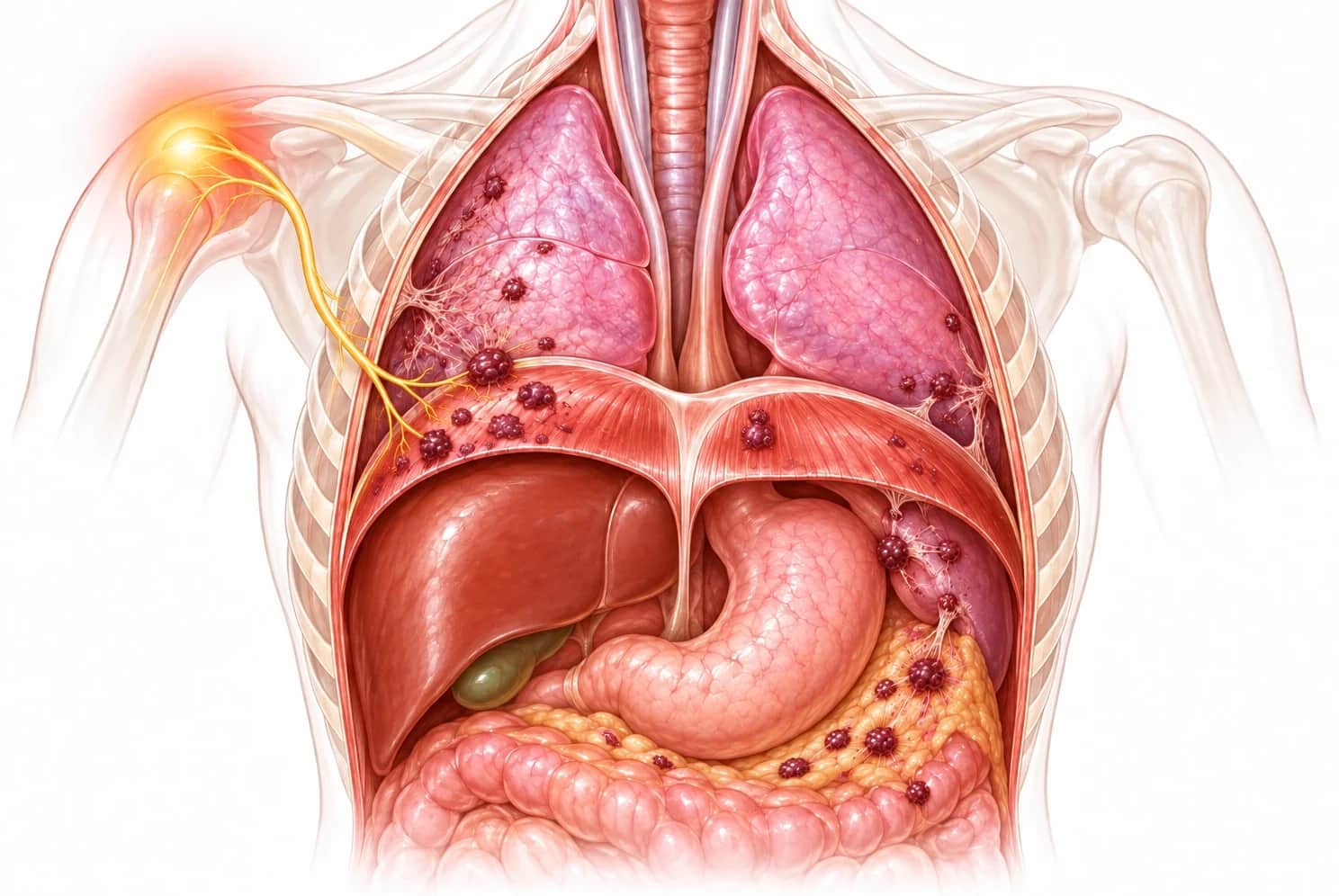
- The diaphragmEndometriosis on its surface, most often on the right side, over the liver.
- Rarely, the chestDisease on the lung lining can collapse a lung around a period; a thoracic surgeon joins the plan.
- The liverRight under the diaphragm, which is why the disease is hard to see and reach.
- The right shoulderThe diaphragm shares nerves with it, so the pain is felt here.
Endometriosis
Why it hurts in the shoulder
The diaphragm shares nerves with the shoulder, so pain from the diaphragm can be felt in the shoulder. What points to endometriosis is the timing: it flares in the days before or during your period, and often hurts more with a deep breath.
Who it’s for
Is it right for me?
When shoulder, chest or rib pain flares with your period, endometriosis was seen on the diaphragm before, or a lung has collapsed around a period.
The shoulder pain comes with your period and is usually on the right, sometimes in the neck or arm. Chest or rib pain is often sharper with a deep breath or a cough. A collapsed lung around a period is rare, but it means the chest needs checking too.
Diaphragm disease is more common when pelvic disease is advanced. Sometimes it was seen at an earlier surgery but not removed, because the surgeon wasn't prepared to. Hormones can calm flares, but they don't remove the disease.
Imaging often misses the diaphragm, so a normal scan doesn't rule it out. What finds it is a surgeon who looks, and is ready to treat what's there.
Often improves
- Shoulder, chest and rib pain that follows your cycle
- Pain with a deep breath around your period
- A definite diagnosis, confirmed by pathology
Won’t fix on its own
- Shoulder or chest pain from other causes, such as the spine, the lungs or the heart
- A lifetime cure: endometriosis is a chronic disease
That's why other causes are ruled out first, and why care can continue after surgery with hormonal therapy when it fits.
Your options
How does it compare?
Planned for, it's removed in the same operation. Found by surprise, it's often only photographed, and another surgery follows.
The difference is preparation. With the diaphragm in the plan, it's treated alongside the pelvic disease, through the same small incisions. If the disease may go through to the chest, a thoracic surgeon is part of the plan from the start. For many, that gives the most lasting relief, with normal routines in 2–3 weeks.
Without that plan, the operation may have to stop, and symptoms continue until the next surgery. Hormone medication can calm flares, but the disease stays, and symptoms often return when the medication stops.
| Compared | Planned excision | Found during another surgery | Hormone medication |
|---|---|---|---|
| What happens | Removed in the same operation as the pelvic disease | Often only photographed or biopsied; a second operation follows | Flares calm; the disease stays |
| If it goes through to the chest | A thoracic surgeon is part of the plan from the start | The operation may have to stop | Can't be seen or treated |
| Afterwards | For many, the most lasting relief; normal routines in 2–3 weeks | Symptoms continue until the next surgery | Symptoms often return when the medication stops |
Planned excision
- What happens
- Removed in the same operation as the pelvic disease
- If it goes through to the chest
- A thoracic surgeon is part of the plan from the start
- Afterwards
- For many, the most lasting relief; normal routines in 2–3 weeks
Found during another surgery
- What happens
- Often only photographed or biopsied; a second operation follows
- If it goes through to the chest
- The operation may have to stop
- Afterwards
- Symptoms continue until the next surgery
Hormone medication
- What happens
- Flares calm; the disease stays
- If it goes through to the chest
- Can't be seen or treated
- Afterwards
- Symptoms often return when the medication stops
From first visit to recovery
What happens, step by step?
A video consultation, imaging when it helps, a plan that includes the diaphragm, then one operation.
It starts with a video consultation, where the timing of your pain matters most: when it starts, which side, and whether it flares with your period or a deep breath. MRI, sometimes CT, can raise suspicion but often misses small spots, so the diaphragm is included in the plan and your consent, ready to be treated when it's found. Insurance and a fixed price are settled before anything is booked.
On the day, both sides of the diaphragm are inspected and the disease removed. Shoulder and upper abdominal soreness are common for a few days. Many people are back to normal routines in 2–3 weeks and to full activity around a month. Three months on, a video check-in goes over your pathology results.
Before surgery
Planning consultation
By video. The timing of your pain matters most: when it starts, which side, and whether it flares with your period or a deep breath.
Testing
MRI, sometimes CT, can raise suspicion and rule out other causes, but often misses small spots. If a lung has collapsed or the chest may be involved, a thoracic surgeon reviews your case.
Your plan
The diaphragm is included in the plan and in your consent, so it can be treated when it's found. Insurance and a fixed price are settled before anything is booked.
Surgery day
The operation
Robotic or laparoscopic, through the same small incisions as the pelvic surgery. Both sides of the diaphragm are inspected, and the disease removed.
The diaphragm is thin, so the chest is sometimes entered during excision; in expert hands that's repaired at once. If the disease is known to go through to the chest, the operation is planned with a thoracic surgeon, sometimes with a camera in the chest (VATS) as well.
Often in the same operation: endometriosis excision · bowel surgery
In the hospital
Most often it is still a same-day outpatient procedure. When it isn't, how long you stay depends on everything treated in the same operation. Shoulder and upper abdominal soreness are common for a few days.
Recovery
Early recovery
Week 1
Gentle walking and deep breathing from the start. Many people walk comfortably within about a week.
Back to normal
Weeks 2–4
Normal routines in 2–3 weeks for many people, and full activity around a month. Heavy lifting and hard core work wait until your team clears you.
Follow-up
Follow-up
3 months
Your pathology results and a video check-in about your shoulder and chest pain, and whether anything more is needed to keep it away.
Your surgeon
Who should do it?
A surgeon trained to operate in the upper abdomen, with a thoracic surgeon in the plan if disease beyond the diaphragm, or in the lungs, may be involved.
Diaphragm disease is easy to miss and hard to reach. Many surgeons who find it during pelvic surgery photograph it and stop, because they aren't trained to operate in the upper abdomen. Dr. Vasilev is a gynecologic oncologist, and operating on the diaphragm is part of that training, so it's treated in the same operation instead of a second one.
“If there's a strong suspicion or evidence of diaphragm or chest disease, the time to plan for it is before surgery, not when you find it.”
Patients often ask
Is my shoulder or chest pain from diaphragmatic endometriosis?
Diaphragmatic endometriosis can cause shoulder or chest pain that tends to be cyclical and frequently right-sided, flaring before or during your period. Many non-gynecologic causes can also explain this pain, especially if it’s left-sided or not tied to your cycle.
How is diaphragmatic endometriosis diagnosed?
The most reliable way to diagnose diaphragmatic endometriosis is minimally invasive surgery to inspect the diaphragm and remove suspicious lesions for pathology when appropriate. Imaging can help guide evaluation, but a normal scan does not rule it out.
Can medication manage diaphragmatic endometriosis, or is surgery needed?
Medication can help many patients manage diaphragmatic endometriosis symptoms, but it does not remove the disease. Surgery becomes more likely when pain continues despite medication, deeper nodules are suspected, or symptoms raise concern for chest involvement.
Can thoracic endometriosis cause a collapsed lung?
Yes, in rare cases, thoracic endometriosis can be associated with a spontaneous collapsed lung that tends to recur around menstruation, called catamenial pneumothorax. Symptoms may include one-sided chest pain, shortness of breath or shoulder discomfort.
You’re on step 1 of 3
Next: Who should operate?What to look for in any surgeon, and Dr. Vasilev’s results.