



Fertility-Sparing Treatment for Adenomyosis: Pregnancy Chances, Symptom Relief, and Pregnancy Risks
Compare excision and non-excisional options (HIFU, RFA, UAE), when to add hormones, and how to plan a safer pregnancy after treatment.
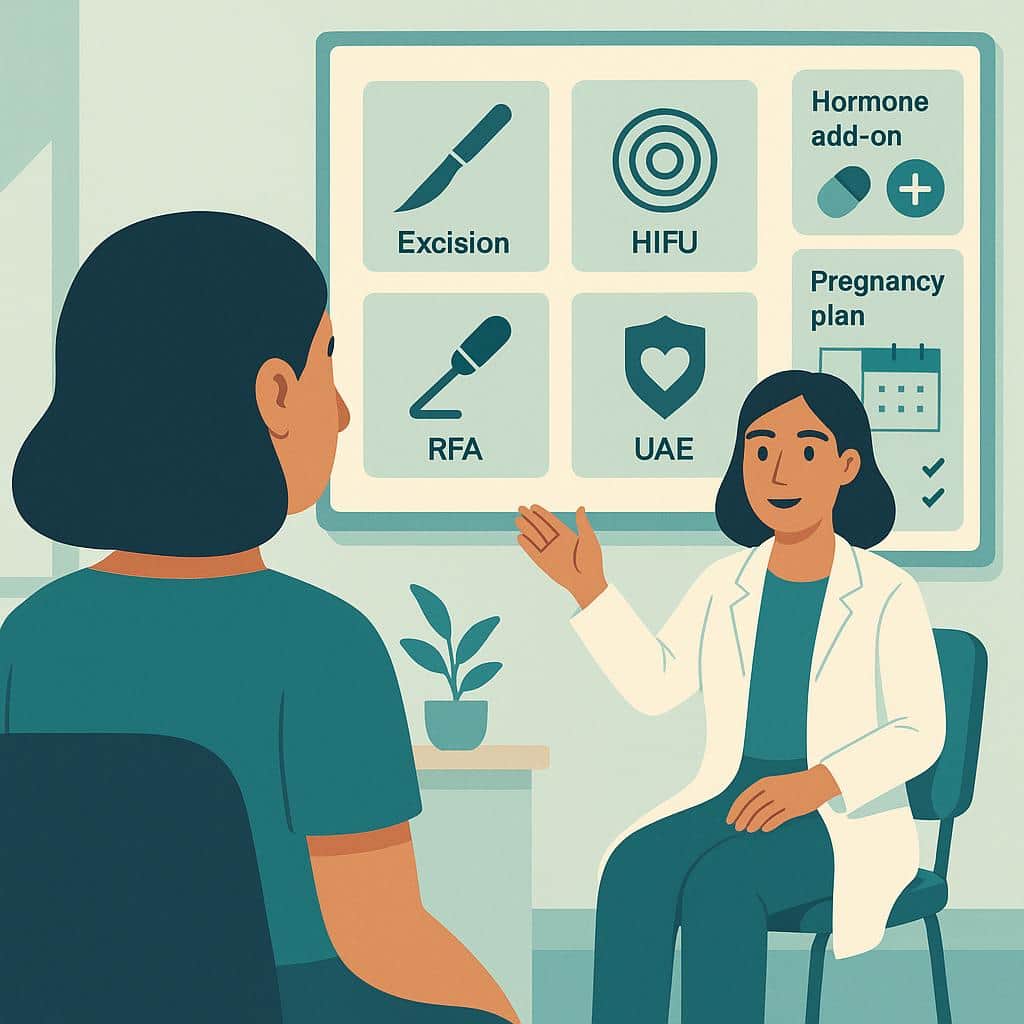
If you have adenomyosis and you want a pregnancy (now or someday), you’re often forced into unfair trade-offs: “control the pain and bleeding” versus “protect the uterus,” and “do something definitive” versus “don’t do anything that could raise pregnancy risk.” It can feel like every option is either too small to matter or too big to risk.
The good news is that uterus-sparing (“conservative”) treatments—both surgical and non-surgical—are increasingly used for people who want to preserve fertility. The harder news is that results vary a lot depending on your type of adenomyosis (focal vs diffuse), where it sits in the uterus, and how thick/affected your junctional zone is. Recent evidence suggests that more than one approach can sometimes lead to pregnancy, but the “best” choice is highly individualized.
Below is a practical guide to the main fertility-sparing options, what pregnancy outcomes look like in real life, what risks to plan for, and what to ask your doctor so you can make a decision you feel at peace with.
Why adenomyosis matters for fertility—and not just because of symptoms
Adenomyosis isn’t only about heavy bleeding and cramping. It can also affect fertility and pregnancy, partly because it can change how the uterus contracts, how inflammation behaves inside the uterine muscle, and how receptive the lining is for embryo implantation. For some people, adenomyosis is “silent” until infertility workups; for others, it’s years of debilitating symptoms before fertility even becomes the question.
One frustrating layer: diagnosis and classification aren’t perfectly standardized. That means one radiology report may call it “diffuse adenomyosis,” another may emphasize “junctional zone thickening,” and another may label a “focal adenomyoma.” Those words matter, because they often predict which treatments are most realistic—and what pregnancy planning should look like afterward.
Option 1: Excisional surgery (adenomyomectomy) — removing adenomyosis while keeping the uterus
What it is: An adenomyomectomy is a fertility-sparing operation where a surgeon cuts out adenomyosis tissue and reconstructs the uterine wall. This is most straightforward when disease is visibly focal (a defined adenomyoma) and more complex when disease is diffuse (widespread involvement of the uterine muscle).
How well it can work for pregnancy: If you have focal adenomyosis, reported outcomes can be encouraging: pregnancy rates over 50% and live birth rates up to about 70% have been described in selected patients. Results are generally less successful in diffuse adenomyosis, where it may be impossible to fully remove disease without weakening the uterus.
What this means for you in practice:
If imaging suggests a well-defined focal lesion—and you have infertility or repeated implantation failure—excisional surgery may be one of the more “direct” ways to change the anatomy and inflammatory environment. But it’s not a casual procedure. Surgeon skill, technique, and reconstruction quality matter enormously, and not every center has deep experience.
Downsides and trade-offs: Excisional adenomyoma surgery can involve blood loss, adhesions, and recovery time. And because it intentionally cuts into uterine muscle, future pregnancy monitoring and delivery planning are not optional—they’re essential (more on this below). Also, evidence suggests that all adenomyosis is at least partly diffuse in addition to the focal adenomyomas. Excision of diffuse adenomyosis is not possible and symptoms can persist after adenomyomectomy if there is enough diffuse adenomyosis remaining after surgery.
Option 2: Non-excisional uterus-sparing procedures (HIFU, RFA, UAE) — treating without cutting out tissue
Not everyone is a good candidate for cutting surgery, and not everyone wants it. There are non-excisional options that aim to shrink, inactivate, or devascularize adenomyosis without removing it.
HIFU (High-Intensity Focused Ultrasound)
What it is: Focused ultrasound energy heats targeted tissue to cause coagulation/necrosis, guided by imaging (often MRI or ultrasound).
Pregnancy outcomes you might hear quoted: In selected patients, pregnancy rates around 40–53% and live birth rates around 35–74% have been reported across studies and techniques. The range is wide for a reason: patient selection, adenomyosis subtype, and definitions of “success” vary.
RFA (Radiofrequency Ablation)
What it is: A probe delivers energy directly to heat and ablate adenomyosis tissue, often with ultrasound guidance (transvaginal or transcervical approaches exist).
Why patients consider it: It can be less invasive than excision and may reduce symptoms with shorter recovery for some people.
UAE (Uterine Artery Embolization)
What it is: An interventional radiology procedure that blocks blood supply to uterine tissue to reduce symptoms and shrink lesions.
Special fertility note: UAE is more established for fibroids than adenomyosis, and fertility planning can be more nuanced. If future pregnancy is a priority, you’ll want a very explicit discussion about ovarian reserve, placental risks, and local expertise with UAE in fertility-preservation scenarios.
Protect Fertility While Managing Adenomyosis
Our specialists are here to help you understand your condition and explore your treatment options.
Schedule Your ConsultationAre non-excisional approaches “as good” as excision for fertility?
A major reality check from pooled evidence is this: some analyses find no statistically significant differences in pregnancy, live birth, or miscarriage rates between excisional and non-excisional approaches. That doesn’t mean they’re identical for you—it means there isn’t definitive proof that one category always wins. Your lesion type (focal vs diffuse), location, and junctional zone changes often drive the decision more than the “brand name” of the procedure.
Add-on hormone therapy: why your doctor may recommend “combo” treatment
Many patients are surprised when the plan is not “procedure and done,” but procedure + hormones, especially around the time of trying to conceive or doing IVF. It is generally best to view it as a process and not an event.
What’s commonly used: GnRH agonists are frequently discussed as an adjunct (before or after a conservative procedure). The goal is usually to suppress estrogen temporarily, calm inflammation, and reduce adenomyosis activity.
How it can feel in real life: GnRH agonists can bring menopause-like side effects (hot flashes, mood changes, sleep disruption, low libido), and sometimes “add-back” therapy is used to make it tolerable. The reason it still comes up is that adjunct hormonal therapy appears to improve outcomes in some settings—especially when paired with a fertility plan (timed conception or IVF).
If you’re exhausted by years of hormonal trial-and-error, it’s okay to say: “I need the shortest effective course,” or “I need a plan that protects my mental health.” You deserve a regimen you can actually live through.
Pregnancy risks after fertility-sparing treatment: the part you should plan for, not fear
Preserving the uterus doesn’t always mean a “normal-risk” pregnancy afterward. Conservative surgery and even some non-excisional treatments can change the uterine wall and placentation environment.
Two risks deserve direct discussion:
Placenta accreta spectrum (PAS): Abnormal placental attachment that can cause severe bleeding at delivery. The risk isn’t the same for everyone, but it’s important enough that you should be counseled and monitored.
Uterine rupture: Reported rates up to about 6% have been described in some series after conservative surgery, especially with diffuse disease and deeper uterine wall reconstruction. That number can sound terrifying—but what matters most is how your individual risk is assessed and managed.
What planning often looks like: close imaging surveillance in pregnancy, delivery in a hospital prepared for complex obstetrics, and in many cases planned cesarean rather than labor. Your doctor should be able to explain why they’re recommending a specific delivery plan based on your surgical history and uterine repair.
How to choose the right approach for your adenomyosis (and avoid generic advice)
The most important predictors mentioned across clinical experience and evidence are often:
- Type: focal vs diffuse
- Location: where in the uterus the lesion sits (and how deep)
- Junctional zone thickness/extent of involvement
If you only take one action step from this article, let it be this: ask your clinician to translate your imaging into a fertility plan. Not just “you have adenomyosis,” but what kind, how extensive, and what that means for each option.
Questions to ask your doctor (bring these to your next visit)
- “Based on my imaging, is this mostly focal or diffuse adenomyosis? Where is it located, and how thick is the junctional zone?”
- “Am I a candidate for adenomyomectomy?”
- “Would you consider HIFU, RFA, or UAE for someone trying to preserve fertility like me? What makes me a good or poor candidate?”
- “What pregnancy and live birth rates do you typically see in patients like me (same subtype/age/IVF history), not just overall averages?”
- “Would you recommend GnRH agonist therapy or another hormonal approach around treatment? For how long, and how will side effects be managed?”
- “If I conceive, what is the plan for pregnancy monitoring and delivery? Do you recommend planned C-section, and at what gestational age?”
Reality check: what we still don’t know (and why your results may differ)
Even though there’s a growing body of literature, a lot of fertility-sparing adenomyosis data comes from small or retrospective studies, and techniques differ from surgeon to surgeon and center to center. There are also few robust randomized trials, so “best option” is rarely a simple, universal answer.
That uncertainty isn’t your fault—and it doesn’t mean you’re out of options. It means your best odds often come from:
- accurate characterization of your disease,
- a team experienced in the specific procedure you’re considering, and
- a thoughtful fertility timeline (natural trying vs IVF, whether to suppress first, and how long to wait post-procedure).
References
Ioannidou A, Louis K, Sioutis D, Panagopoulos P, Theofanakis C, Machairiotis N. Conservative Surgical Management of Adenomyosis: Implications for Infertility and Pregnancy Outcomes—A Perspective Review. Journal of Clinical Medicine. 2025. DOI: 10.3390/jcm14196956
Quick Answers
How is multi-organ endometriosis treated without organ removal?
In many multi-organ cases, the goal is conservative surgery: removing endometriosis while preserving the organs themselves. That typically means meticulous excision of disease from surfaces and deeper planes around the bowel, bladder, ureters, ovaries, and pelvic sidewalls—freeing organs from scar tissue and restoring normal anatomy without taking the organ out. Because endometriosis can hide in distorted or “frozen” anatomy, the safest way to preserve organs is often a highly precise approach that can dissect around vital structures.
In our practice, we use robotic excision to improve visualization and fine-control dissection, which is especially helpful when disease involves multiple compartments or has been operated on before. When endometriosis is close to structures like the ureters, bowel, diaphragm, or certain nerves, treatment planning may include coordinated work with other surgical specialists so the disease can be fully addressed in one operation while still prioritizing organ-sparing techniques.
Organ removal is usually considered only when an organ is severely damaged, there are multiple large endometriomas that can’t be safely managed with tissue-sparing techniques, fertility-safety concerns arise (like a badly damaged tube), or there’s concern for tumor or malignant change. If you’re trying to avoid organ removal, we can help map likely disease sites, clarify your priorities (pain relief, function, fertility), and outline what organ-preserving excision could realistically look like in your specific case—then build a surgical plan around that.
How much time off work do I need after endometriosis surgery?
Most people need about 2–3 weeks off work after minimally invasive endometriosis excision, especially if your job is mainly desk-based and you can ease back in. With robotic excision, patients often go home the same day or next day, start walking comfortably within about a week, and many feel ready for a gradual return to typical daily routines in that 2–3 week window.
The exact time off depends less on the incision size and more on what we need to treat during surgery—for example, ovarian endometriomas, bowel/bladder/ureter involvement, extensive scar tissue (“frozen pelvis”), or additional procedures like appendix removal or adenomyosis-related surgery. More complex, multi-organ cases can mean more fatigue, more activity restrictions, and a higher chance of needing an overnight stay, which can extend the time you’ll want to plan away from work.
In most straightforward recoveries, many patients are back to full activity by about a month. If you tell our team what you do for work (lifting, long shifts, travel, on-your-feet all day vs remote/desk), we can help you plan a realistic time-off request and a safer return-to-work ramp based on the surgical plan we’re building for you.
When is hysterectomy recommended for adenomyosis?
A hysterectomy is typically considered for adenomyosis when symptoms are severe and clearly uterus-driven—most often heavy bleeding (sometimes with anemia), intense cramping, pelvic pressure, and daily quality-of-life disruption—and you’re not planning future pregnancy. It’s the most definitive option because adenomyosis lives within the uterine muscle, so removing the uterus removes the source of the problem.
In practice, we usually weigh hysterectomy most strongly when conservative options haven’t brought acceptable relief, aren’t tolerated, or don’t fit your goals. The decision also depends on the pattern and extent of disease (diffuse adenomyosis versus a more focal adenomyoma that may be removable while preserving the uterus) and whether endometriosis may also be present. If endometriosis is part of the picture, it’s important to know that hysterectomy alone doesn’t treat disease outside the uterus—durable symptom relief depends on addressing all pain generators.
If you’re wondering whether you’re at the point where hysterectomy makes sense, our team can help clarify what’s most likely driving your symptoms, review imaging, and walk you through uterus-preserving versus definitive surgical paths so you can choose the option that best matches your relief and fertility priorities.
Which adenomyosis symptoms most affect daily life?
Adenomyosis symptoms that most disrupt quality of life usually come from two main issues: how the uterus bleeds and how it hurts. Many patients describe heavy or prolonged periods that interfere with work, school, travel, and sleep—sometimes with flooding, frequent pad/tampon changes, and fatigue that can follow significant blood loss. Severe period pain (often more than “normal cramps”) is also common, and it can feel deep, aching, or pressure-like, sometimes accompanied by an enlarged, tender uterus and a sense of pelvic heaviness or bloating.
Outside of the period itself, adenomyosis can contribute to chronic pelvic pain, pain with sex for some people, and bowel or bladder discomfort—especially when symptoms flare around the menstrual cycle. It can also overlap with endometriosis, and when both are present symptoms may intensify or become harder to tease apart. If your day-to-day life is being shaped by bleeding, pain, pressure, or fertility stress, our team can help you sort out whether adenomyosis, endometriosis, fibroids, or more than one condition may be driving the pattern—and what next-step options make sense for your goals.
Why do I have chronic fatigue and pelvic pain?
Chronic fatigue plus pelvic pain often feels “unexplainable” because it’s rarely caused by just one issue—and many of the most common drivers don’t show up on routine labs or a quick ultrasound. Endometriosis and adenomyosis can cause persistent pelvic pain, painful periods, bowel/bladder symptoms, and deep fatigue through inflammation, disrupted sleep, heavy bleeding (and possible iron deficiency), and the sheer energy cost of living with ongoing pain. It’s also common for more than one gynecologic condition to coexist—like fibroids, polyps, or benign cysts—so a single label may not fully match what you’re experiencing.
Another reason symptoms can persist is that the nervous system can become more pain-sensitive over time (often called central sensitization), meaning pain can spread, linger outside your cycle, or feel disproportionate to what imaging shows. In those cases, symptom relief alone can miss the bigger picture: we think in terms of both treating disease (for example, addressing endometriosis lesions or uterine drivers like adenomyosis/fibroids) and building a personalized pain-management plan so your body can “turn down the volume” on pain signals.
If your fatigue and pelvic pain have been brushed off or left without a clear plan, our team can help you sort through the likely contributors, including endometriosis/adenomyosis and common coexisting conditions, and map next steps that fit your goals. You can explore our educational resources on fatigue, chronic pelvic pain, and comprehensive treatment approaches, and reach out to schedule a consultation when you’re ready.