


How Endometriosis Contributes to Infertility
How endometriosis impairs fertility—mechanisms, pathways, and treatments.
Endometriosis and Fertility: Essential Insights
Endometriosis is a complex and often misunderstood condition that can substantially affect fertility. Gaining clarity on how it develops, why it occurs, and the ways it can influence conception is important for identifying effective treatment strategies.
What Is Endometriosis?
Endometriosis is a benign, estrogen-dependent disorder that affects approximately one in ten cisgender women during their reproductive years. It may also affect transgender men, where the condition may be present at a higher percentage. Although cases have been reported in cisgender men, they are exceedingly rare. The discussion of fertility here focuses on impacts involving the uterus, Fallopian tubes, and ovaries.
The condition is defined by the presence of endometrial-like tissue outside the uterus. These implants are often located within the pelvis—on the ovaries, fallopian tubes, and the outer surface of the uterus—though in some instances they extend beyond the pelvic region. While an estimated 10–15% of cisgender women of reproductive age are affected, endometriosis is even more prevalent among those facing infertility, occurring in up to 25%–50% of this group. The underlying cause remains under investigation, and its impact on fertility is multifactorial and complex.
How Endometriosis Develops: Leading Theories
Multiple theories aim to explain the pathogenesis of endometriosis, reflecting the complexity of the condition and its varied presentation.
Retrograde Menstruation
The oldest and most widely known theory suggests that menstrual blood containing endometrial cells flows backward through the fallopian tubes into the pelvic cavity. These cells then attach to peritoneal surfaces, proliferate, and form endometriosis implants.
Coelomic Metaplasia and Metastatic Spread
Another perspective posits that cells in the peritoneum can transform into endometrial cells, a process called coelomic metaplasia. A separate but related hypothesis proposes that endometrial tissue spreads via the bloodstream or lymphatic system to distant sites, accounting for implants found outside the pelvis.
Altered Immunity
A further theory proposes that individuals with endometriosis may have immune system alterations that fail to clear endometrial cells from the peritoneal cavity. This immune dysfunction may also facilitate disease progression by promoting the survival and growth of implants.
Stem Cells and Genetics
Emerging research points to the involvement of stem cells and genetic predisposition. Bone marrow–derived stem cells may differentiate into endometriosis cells, contributing to ectopic endometrial-like tissue. Genetics also appear to play a substantial role, with a first-degree relative affected by the disease increasing a person’s risk by sevenfold.
Learn more: Current Knowledge on Endometriosis Etiology: A Systematic Review
Struggling with Endometriosis and Infertility?
Our specialists are here to help you understand your condition and explore your treatment options.
Schedule a ConsultationHow Endometriosis Can Cause Infertility
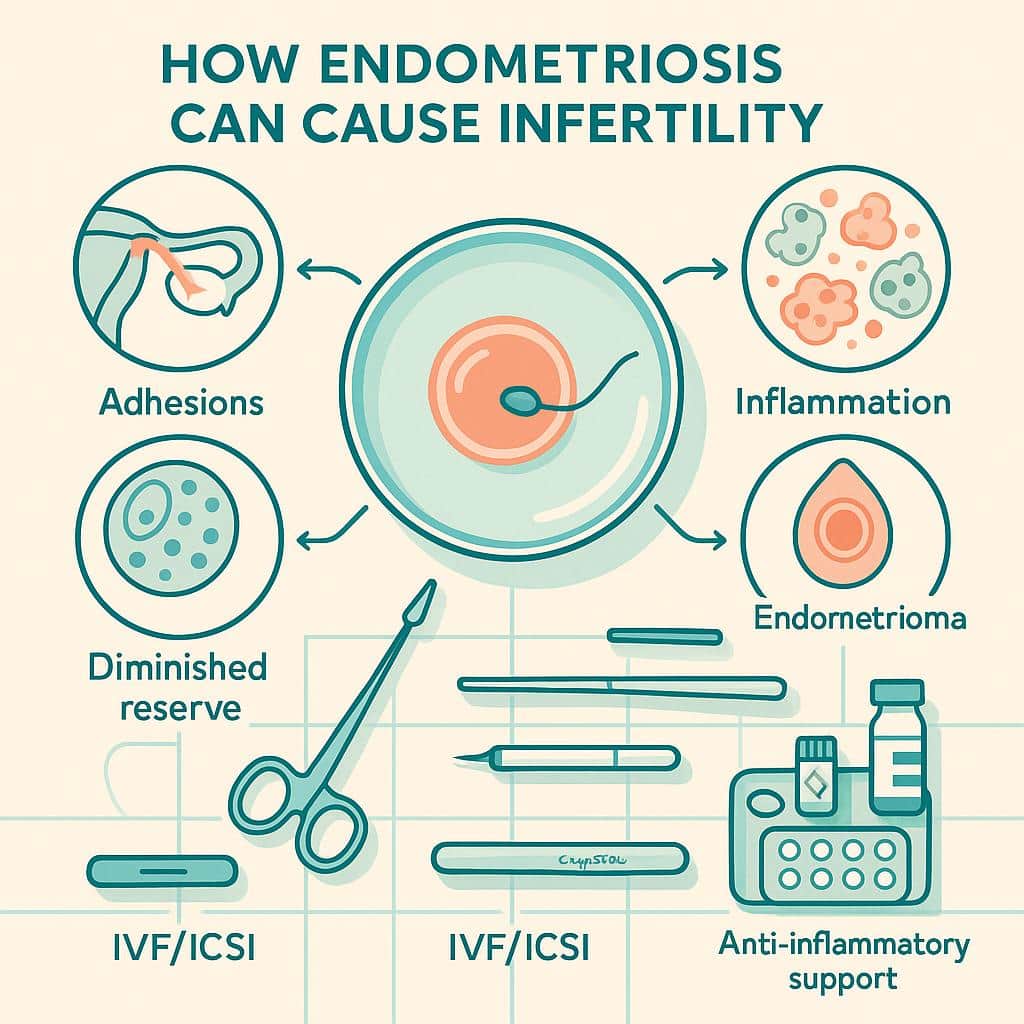
Endometriosis can impair fertility through several mechanisms that affect gametes, embryo transport, and implantation.
Effect on Gametes and Embryo
Endometriosis may influence the production and quality of oocytes and can also affect sperm function and embryo health. Endometriomas and the inflammatory environment they create can negatively affect oocyte production and ovulation.
Effect on Fallopian Tubes and Embryo Transport
Inflammation associated with endometriosis can disrupt fallopian tube function and normal uterine contractions. These changes can impair tubal motility and hinder the transport of eggs, sperm, and embryos.
Effect on the Endometrium
Endometriosis can alter the uterine lining, potentially leading to implantation failure. Research indicates that changes in gene expression within the endometrium may reduce its receptivity to embryo implantation.
Treatment Options for Endometriosis-Associated Infertility
Approaches to managing infertility related to endometriosis include expectant management, medical therapy, surgical intervention, and assisted reproductive technologies, with the goal of improving reproductive outcomes based on disease severity and individual circumstances.
Expectant Management
Some individuals with mild to moderate endometriosis may conceive without intervention, particularly younger patients without additional fertility problems. Despite the overall reduction in fertility rates associated with endometriosis, careful observation can be an appropriate option in selected cases.
Surgical Treatment
Surgery can serve both diagnostic and therapeutic purposes. The primary aims are to remove or reduce endometriosis implants, restore normal pelvic anatomy, and lessen inflammatory effects. These outcomes may improve fertility, especially in those with more severe disease.
Assisted Reproductive Technology
In vitro fertilization (IVF) is currently the most effective treatment for infertility associated with endometriosis. It is particularly beneficial for individuals with severe endometriosis or for those who have not achieved pregnancy with other treatments.
Medical Treatment
Hormonal medications—including combined oral contraceptives, progestins, danazol, and gonadotropin-releasing hormone agonists or antagonists (GnRH analogs)—are commonly used to reduce disease severity and alleviate symptoms. However, these therapies have not demonstrated significant benefit in treating endometriosis-associated infertility itself.
The Road Ahead: Potential Future Treatments
As research advances, novel therapies targeting abnormal gene expression and inflammatory pathways are being explored. Stem cell–based approaches and genetic interventions also hold promise for addressing endometriosis-associated infertility. Continued scientific progress offers hope for more effective strategies to manage this condition and improve fertility outcomes.
References
Macer ML, Taylor HS. Endometriosis and infertility: a review of the pathogenesis and treatment of endometriosis-associated infertility. Obstet Gynecol Clin North Am. 2012 Dec;39(4):535-49. doi: 10.1016/j.ogc.2012.10.002. PMID: 23182559; PMCID: PMC3538128.
Quick Answers
How much time off work do I need after endometriosis surgery?
Most people need about 2–3 weeks off work after minimally invasive endometriosis excision, especially if your job is mainly desk-based and you can ease back in. With robotic excision, patients often go home the same day or next day, start walking comfortably within about a week, and many feel ready for a gradual return to typical daily routines in that 2–3 week window.
The exact time off depends less on the incision size and more on what we need to treat during surgery—for example, ovarian endometriomas, bowel/bladder/ureter involvement, extensive scar tissue (“frozen pelvis”), or additional procedures like appendix removal or adenomyosis-related surgery. More complex, multi-organ cases can mean more fatigue, more activity restrictions, and a higher chance of needing an overnight stay, which can extend the time you’ll want to plan away from work.
In most straightforward recoveries, many patients are back to full activity by about a month. If you tell our team what you do for work (lifting, long shifts, travel, on-your-feet all day vs remote/desk), we can help you plan a realistic time-off request and a safer return-to-work ramp based on the surgical plan we’re building for you.
Why does ovarian cyst pain keep coming back?
Ovarian cyst pain can feel “recurrent” for a few different reasons. Some cysts are functional (they form with ovulation and then resolve), so the pain returns in a similar spot month after month even though it’s not the exact same cyst. In other cases, the cyst itself can come back or persist—especially if it’s an endometrioma (an ovarian cyst caused by endometriosis), which can behave differently than a simple cyst and may be associated with deeper pelvic disease.
Another common reason is that the cyst isn’t the whole story: endometriosis on the pelvic sidewall, uterosacral ligaments, bowel, bladder, or around the ovary can irritate the same nerves and tissues and make it feel like “my cyst is back” when the driver is actually inflammatory disease nearby. Adhesions (scar-like bands) can also tether the ovary and cause recurring pulling or sharp pain, even when imaging doesn’t show a large cyst. If your pain cycles, escalates, returns quickly after a “normal” ultrasound, or keeps recurring despite prior treatment, our team can help you map the pattern, interpret imaging with an endometriosis lens, and decide whether targeted evaluation and—when appropriate—excision surgery is the next best step.
Can endometriosis cause infertility and pelvic pain in your 20s?
Yes. Endometriosis can absolutely show up in your late 20s and it can be a driver of both chronic pelvic pain and fertility challenges. Pain can include severe or worsening period cramps, pain with sex, bowel or bladder pain, and “flare” patterns that track with your cycle—although symptom severity doesn’t always match how much disease is present.
Endometriosis can affect fertility in several ways, including adhesions that distort tubo‑ovarian anatomy, inflammation and immune signaling that interferes with fertilization or embryo development, and ovarian factors—especially when endometriomas are involved. For some patients, the uterine environment also matters, particularly when adenomyosis is present alongside endometriosis. In our practice, we focus on listening to your full symptom and fertility story and then building an evaluation that looks for endometriosis while also checking for common look‑alikes or coexisting issues, so we can tailor a plan to your goals—whether that’s pain relief, preserving fertility, or both.
Why do I have chronic fatigue and pelvic pain?
Chronic fatigue plus pelvic pain often feels “unexplainable” because it’s rarely caused by just one issue—and many of the most common drivers don’t show up on routine labs or a quick ultrasound. Endometriosis and adenomyosis can cause persistent pelvic pain, painful periods, bowel/bladder symptoms, and deep fatigue through inflammation, disrupted sleep, heavy bleeding (and possible iron deficiency), and the sheer energy cost of living with ongoing pain. It’s also common for more than one gynecologic condition to coexist—like fibroids, polyps, or benign cysts—so a single label may not fully match what you’re experiencing.
Another reason symptoms can persist is that the nervous system can become more pain-sensitive over time (often called central sensitization), meaning pain can spread, linger outside your cycle, or feel disproportionate to what imaging shows. In those cases, symptom relief alone can miss the bigger picture: we think in terms of both treating disease (for example, addressing endometriosis lesions or uterine drivers like adenomyosis/fibroids) and building a personalized pain-management plan so your body can “turn down the volume” on pain signals.
If your fatigue and pelvic pain have been brushed off or left without a clear plan, our team can help you sort through the likely contributors, including endometriosis/adenomyosis and common coexisting conditions, and map next steps that fit your goals. You can explore our educational resources on fatigue, chronic pelvic pain, and comprehensive treatment approaches, and reach out to schedule a consultation when you’re ready.
Why is my period pain so severe it disrupts my daily life?
Severe, life-disrupting period pain isn’t “normal cramps,” and it often points to an underlying driver that deserves a real explanation—not just symptom masking. One common cause is endometriosis, where tissue similar to the uterine lining grows outside the uterus and can irritate pelvic structures, trigger inflammatory chemicals, and sometimes involve organs like the bowel or bladder. Another key point is that pain severity doesn’t reliably match “stage,” so someone can have intense pain even if imaging looks normal or disease appears limited.
When period pain is severe, worsening over time, starts years after your first period, or comes with heavy bleeding, painful sex, bowel pain with periods, urinary pain, or fatigue, we think in patterns—because endometriosis and related conditions can overlap with pelvic floor dysfunction, nerve pain/central sensitization, GI dysbiosis, vascular issues, or adenomyosis. Our approach is to take your full timeline and flare pattern seriously and then tailor evaluation with careful exam and expertly interpreted imaging when helpful. If your pain is disrupting school, work, relationships, or daily functioning, reach out to schedule a consultation—our team can help you identify what’s driving it and map out a plan aimed at lasting relief.